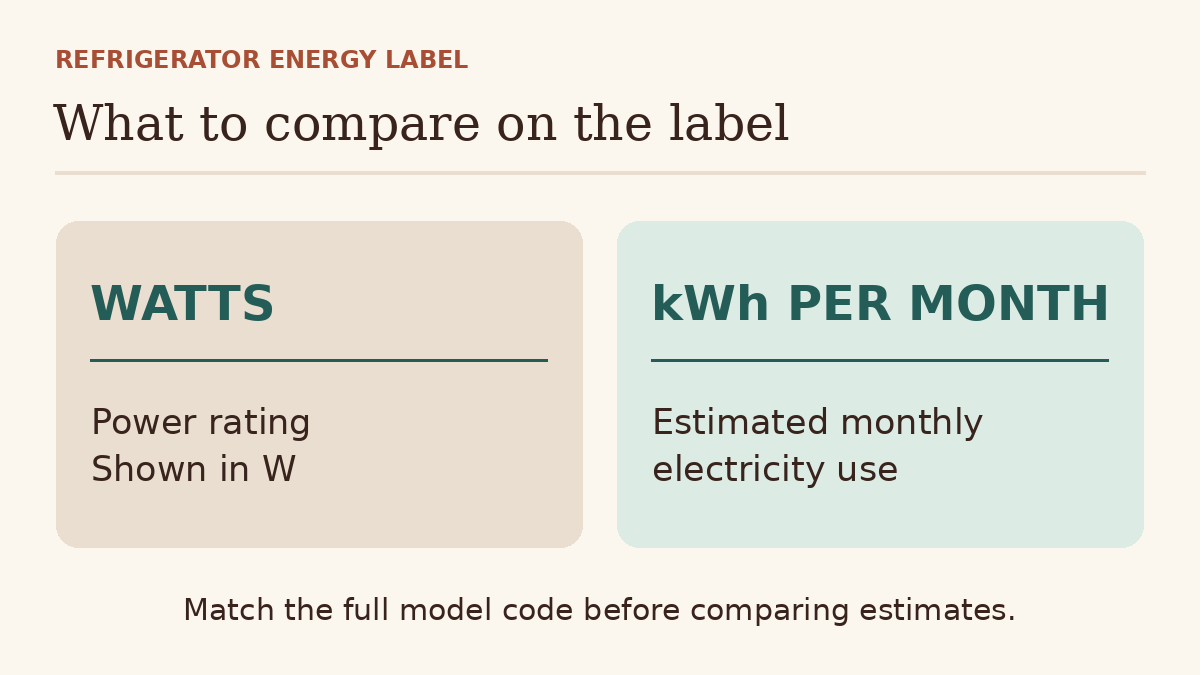
Two refrigerators can list the same wattage and still have different monthly energy estimates. If you’re comparing models for a Philippine home, look for kWh per month on the energy label. That number gives you a starting point for comparing electricity use before you decide whether a larger freezer, a different door layout or a lower upfront price matters more.
Read the monthly estimate and the wattage separately
Watts describe power. Kilowatt-hours describe energy used over time. On the Department of Energy’s list of refrigerating appliances, the power rating in watts and the estimated monthly electricity consumption in kWh appear in separate columns. Multiplying the rated wattage by every hour the fridge is plugged in assumes that it draws that power continuously. Refrigerators can cycle on and off as they maintain their interior temperature. The label’s monthly figure is a more useful starting point for this comparison. See the Philippine DOE issuance list and Virginia Cooperative Extension’s explanation of appliance energy use.
Match the full model code first
Ask for a clear photo of the label and the appliance’s model code, including the letters after the main number. If you’re shopping online, compare the code in the listing with the photographed label. A product title that just says “inverter” or gives a capacity leaves you without the information needed to find the exact entry. If the numbers in the listing and the photographed label differ, ask the seller which model would actually be delivered before comparing it with another fridge.
The DOE register gives a concrete example. Entries 17 and 18 list two Panasonic frost-free refrigerators at 90 watts each. The NR-BV320G is listed at 290 liters and 28.2 kWh per month. The NR-BC360X is listed at 322 liters and 30.6 kWh per month. Both show a performance rating of 4 in that register. These are examples of how to read the columns. The register entries give no information about a current seller, stock or price. Check the two rows in the DOE register.
Compare the fridges that fit your kitchen and groceries
Set aside models that are too large for your space or too small for the way you shop. Measure the opening and check the manufacturer’s installation instructions for clearance and door swing. If you freeze meals in batches, compare freezer layout as well as overall capacity. Two models with similar total volume can offer different amounts of space in the section you use most. Once you’ve narrowed the list to models you could live with, put their monthly kWh figures side by side.
Keep the energy performance rating in its own column. In the DOE example, the same rating appears beside two different monthly consumption estimates. If your question is how much energy each fridge is estimated to use, look directly at the kWh figures. This is the same comparison habit you can use when comparing grocery packs of different sizes: write down what each number measures before judging the difference.
Put the difference in pesos if it helps you decide
Multiply a model’s stated monthly kWh by the peso-per-kWh figure you choose for your comparison. Use the same rate for each model. For example, a gap of 2.4 kWh per month is about ₱29 at an illustrative ₱12 per kWh. That rate is a round number for the arithmetic. Use your own utility’s applicable rate for a more relevant estimate, and expect the amount to change when rates or household use change. Virginia Cooperative Extension shows the same calculation in its appliance energy guide.
Before paying, save the model code, the label photo and the quoted price together. You can compare the upfront price, capacity and energy estimate without relying on the product title alone. The label can help you choose between similar models. Your household bill will reflect how you use the appliance and what your utility charges.
Sources checked November 29, 2026, Philippine time.
Leave a Reply